Pricing your handmade products is one of the most important decisions you will make in your business, and it’s one that is very easy to get wrong, even if you follow a framework.
This isn’t because it’s complicated maths. The calculations are actually pretty simple.
The tricky part is making sure that everything is included, and included in the right part of the calculation, and that’s where a lot of us go wrong.
And when it goes wrong, you get a business that kind of looks like it’s working, kinda feels like it’s working, but is actually losing money every time you make a sale.
You would think that you would know. That it would be obvious. But it’s very easy to miss and I’ve seen this happen with a LOT of makers, even those who looked very successful from the outside.
And I’ve seen how hard it is to fix, once it’s taken hold.
So before we get into the mechanics of how to price your work (and we will … in depth) I want to make sure you understand why getting your prices right now matters so much more than you might think.
Because, when this is wrong, all of the things you do to grow your business actually make things worse.
Why pricing matters more than you think (and why it matters now)
Most makers who don’t yet have a profitable business make the same assumption about what will solve their problem.
More sales.
They need to do more shows. Sell in more places. Post more on social media. Get better at marketing. And so they pour more time, more energy, more of themselves into the business.
But what happens when you’re working as hard as you can, and actually making a lot of sales, but the money still isn’t there?
More sales isn’t always the answer. Because what you really want isn’t more sales. It’s more money.
And when your pricing is wrong, every sale you make costs you money.
That’s right. Every time you sell a product, you lose money and you get closer to a crisis point that is inevitable unless something changes.
You might think that something so obviously damaging to your business would be easy to spot. You might think that you couldn’t possibly make this kind of mistake and not know about it.
But you’d be wrong. And this is partly because it’s quite difficult to spot where the money is flowing into and out of your business.
It’s difficult to match up the costs and the income and see them side by side.
This is partly about timing. You might pay for a hotel for a craft fair months before the show. You might buy materials in bulk and only sell products made from them over time.
The costs are spread out over a long period, and so it’s easy to forget that when the sales come, they’re not pure income. They’re paying back expenses you might already have forgotten about.
This makes it quite tricky to see the full picture of your business’s profitability and you can end up with a distorted picture in your mind about how you’re doing.
Sometimes this is as much about choice as it is about inexperience.
Maybe we don’t want to see it or think about it. We prioritise feeling good and feeling like we’re doing well, over the reality of actually doing well.
It’s a very human response to a situation that is genuinely hard to see clearly. But what it causes, over time, is a slow sucking away of the capital you’ve put into your business and then, quite often, your own personal savings as well.
The turning point
There are usually a couple of turning points at which we are no longer able to avoid it. We are forced into facing the fact that maybe things are not okay.
One is when you simply run out of capacity.
You’re at your limit in terms of what you can make. You can’t do any more. You can’t work any harder. And you’re still not making enough to pay yourself properly. The model reveals itself as unsustainable.
Another is when you run out of money. Many makers subsidise their businesses from savings or from income from other work.
In fact, we’re repeatedly told that we shouldn’t expect to be profitable right away because businesses require investment. But when we are effectively subsidising unsustainable pricing, it’s unavoidable that eventually our money runs out and cashflow becomes an immediate crisis. Then the business falls in on itself.
At either of those points, it’s actually quite rare for people to identify pricing as the cause.
More commonly, they reach one of two conclusions: that they personally aren’t cut out for this, or that a handmade business simply cannot make real money. That it’s structurally impossible.
I’ve heard both of these arguments. Many times. Both are wrong. But because the real cause is so difficult to see, these are the kinds of conclusions that are easy to reach.
The reason I’m telling you this before we do anything else is because fixing your pricing once you’ve built a business around the wrong numbers is really painful.
You may have a loyal customer base who love your work and buy willingly at your current prices. But those prices aren’t sustainable. And moving to the right price can mean losing some or all of them.
It means explaining to people why your prices have gone up.
It can mean the hard, painful work of learning how to elevate the perceived value of your products, with better photography, different packaging, new platforms.
And sometimes it means that your current product range can’t work and you have to pivot your entire business to sell something else.
All of that is hard, expensive, and emotionally draining. Many people don’t have the stomach for it after years of running a business that’s been giving them so little back.
Getting your pricing right isn’t something you have the luxury of “figuring out later.” It can do so much damage to just “see how it goes.”
Nobody sets out to build a business on an unsustainable foundation. Nobody wants that.
So let’s build it properly.
The principle that underpins everything
Before we get to the models, there is one principle that I want you to hold onto throughout this process, because it is the key to putting a stop to excluding costs from your pricing because they’re complicated or expensive.
If your customer isn’t paying for it, YOU ARE.
Every single cost in your business has to be covered by the price your customer pays.
EVERY. SINGLE. ONE
When anything that you pay for is not accounted for in your pricing, you pay for it yourself, out of your own pocket, with every sale you make.
This sounds obvious when you say it out loud. And yet most makers are missing significant costs from their prices without realising it. We’ll come back to what those costs are.
But first, let’s look at how most makers actually arrive at a price, and where those approaches can go wrong.
The three pricing models
There are many models for pricing your work. Today, we’re going to talk about three of the most established ways of pricing physical products.
Most makers use at least one of these, maybe without knowing its name.
Understanding what each one does, what it doesn’t do, and how they relate to each other, is the foundation of knowing how to price your work for profit and income.
Model 1: Cost-plus pricing
Cost-plus pricing is the most well known and the most widely used pricing model.
You add up every cost involved in making and selling a product, add a profit margin, and the result is your minimum viable price.
This is the LEAST you can charge without losing money on every sale.
I believe that everyone’s pricing calculations should start here.
That doesn’t mean that Cost-plus pricing is the best model (it isn’t always), but it does give you one of the most valuable pieces of information about the potential profitability of your business. Your minimum price (based on your current workflow and spending).
It makes it very clear to see that you cannot drop below this price (either with your regular prices or with discounts and special offers) without subsidising every customer who buys from you.
Cost plus pricing tells you whether you can sell this product without losing money. It gives you a common sense place from which to start thinking about how to turn what you make into an income.
Here’s the formula I use for calculating prices for handmade products.
Materials + Making Labour (hours x hourly rate)
+ Overheads (total overheads /annual making hours x hours per product)
+Equipment (purchase + maintenance / lifetime units produced)
+ Profit Margin
= Wholesale Price
+Selling Costs
= Retail Price
We’ll come back to the two different prices and what they mean.
But let’s look at where this calculation often goes wrong.
Most makers have a rough idea of the cost of the materials that go into making a piece.
It’s the other components where things start to go wrong – because they either get missed, undervalued or deliberately excluded.
Making Labour
Making labour is your time spent making the product, multiplied by an hourly rate that actually reflects what your time is worth.
A lot of makers either don’t include their labour at all, particularly when they’re starting out and don’t feel like they’ve “earned” a rate yet, or they use a rate that is essentially minimum wage. Your time has a cost. Your skills and craftsmanship has real value. It should be reflected in the price.
Overheads
Overheads are all the ongoing costs of running your business that don’t attach to any single product but have to be covered across everything you make.
Your studio or workspace costs, utilities, insurance, safety testing, even some software subscriptions. These costs exist and have to be paid whether you make one product or a thousand.
To include them in your pricing, you work out your total overheads for the year, divide them by the number of hours you spend making in a year, and apply that cost-per-making-hour to each product based on how long it takes to make.
It sounds complex, but once you’ve done the calculation it becomes a number you can apply consistently.
An important note: you might have noticed a problem with this calculation – we’re adding the overhead cost to every product you MAKE in a year, not every product you SELL in a year. Why are we doing it this way when you might not sell them all?
It’s because this is already a fairly difficult calculation that requires some prediction. And it’s easier to predict how much you might be able to make, than it is to predict how much you’re going to sell, when you might not have much experience of that.
That’s why it is important to know that this calculation isn’t exact. It’s a starting point and you will need to adjust it as you get a better sense of your rate of sales over the course of a year. This will give us a rough idea for now and get you started – but it needs to be monitored to make sure that you are recovering all of your overhead costs in your pricing.
Equipment costs
Equipment is something almost nobody accounts for properly. Depending on your creative medium, you’ll probably have at least one expensive piece of equipment used in the production of your work. Maybe a sewing machine, a kiln, a specialist printer, or a heat press.
Maybe you bought it before you started your business, or with the original “seed money” that you started with.
It feels like it has already been paid for. And it has – out of your own money. But at some point every piece of equipment wears out. It needs maintaining. It needs replacing.
If you don’t want to buy another one out of your own money, then the cost of your equipment belongs in the price of every product you sell. You can calculate it by estimating the number of products it will help you produce, over its lifetime – and dividing the cost between them.
Plus there is also non-making equipment. General business equipment, such as your computer, your phone, your label printer, also has a cost per making hour that needs to be factored in.
Profit margin
Profit margin is the last component in your wholesale price, and it’s the one most likely to be treated as optional. It isn’t. Profit is not a bonus on top of what you need. It’s the engine of growth for your business – something that allows you to invest in bigger equipment, new staff members or education and training. It’s the place that covers any other shortfalls. And it’s often the mechanism by which you take money out of your business and put it into your bank account.
Without it, you’re stuck funding anything new out of your own money again. As we build our businesses, we want to get away from that.
Selling Costs
Selling costs are the most frequently misunderstood, across the makers I’ve worked with. And they’re worth spending some time on, because understanding them properly can completely change how you think about handmade business.
A lot of makers don’t realise that, regardless of who sells your product, there is a cost involved in selling it that must ultimately be paid for by the end customer.
That size of that cost may change, depending on who does the selling – but it’s always there.
When a shop or gallery sells your work, the selling cost is easy to see.
It’s their commission or wholesale margin. You can see it. You can resent it if you want to, but you can’t ignore it. And you know that you need to account for it.
It’s less obvious when you sell your own work, through your website, at a craft fair, or through your own social media. That’s because it’s paid for with your time – and often not recovered through your prices.
So why do we believe that the hours we spend making a product should be paid hours, but the hours we spend selling it should only be paid hours when someone else is doing the work?
The hours you spend at a craft fair. Your labour at the event itself – the setting up, talking to customers, packing down. The hotel you booked. The petrol. The hours you spend writing product descriptions, doing product photography, managing your social media, answering customer enquiries.
All of that is the cost of selling. As is the cost of your website, your email marketing software and your social media scheduler.
And when I put it to makers that these costs need to be in their prices, the response is often the same: “If I included all of that, I wouldn’t make any money.”
Which is, of course, exactly the point.
If those costs aren’t in your price, you are paying them yourself. Every fair you do, every product description you write, every hour you spend on Instagram. You’re funding that out of your own pocket.
And of course you can’t make money, because so many of your working hours are spent on things you don’t get paid for.
You need to start considering that there are different roles you take on in your business. You’re not just a maker.
When a shop sells your work, it’s easier to see that there are two separate roles: you are the maker, they are the retailer. The maker’s costs and the retailer’s costs are distinct, and both have to be covered.
What’s much harder to see is that when you sell your own work, you are playing both roles simultaneously. You are the maker AND the retailer.
Both sets of costs are real. And both have to be in the price.
I’ve had this conversation with makers who have been selling wholesale for years, who work with multiple retailers, who understand perfectly well how retail margins work, and they still don’t see themselves as a retailer when they sell direct.
It’s a mindset shift more than a calculation, but it’s one of the most important shifts you can make. Once you see both roles clearly, you can price both of them properly.
And the practical implication is this: you need to calculate your wholesale price AND your retail price, regardless of how you sell.
Your wholesale price ensures you get paid a profitable price when you MAKE a product.
Your retail price ensures you get paid a profitable price when you MAKE AND SELL a product.
You need to be profitable at the wholesale price. Always. You also need to be profitable at the retail price, if you sell direct to the customer.
Because there is a cost to selling your work, whoever does the selling. You need to ensure that your prices can cover those selling costs because without them, you are essentially subsidising your customers by doing a large amount of work for free.
Model 2: Competitor-based pricing
Competitor-based pricing is the model most makers reach for when they don’t know what else to do. You look at what other makers or retailers charge for similar products, and you use that as a reference point for your own prices.
I understand why people do this. When you’re starting out, it feels like the most concrete, reliable information available.
Other people are selling things. There are real prices to look at. It feels safer than trying to work out your own numbers from scratch.
And used carefully, with full awareness of its limitations, it does have a role.
Looking at what the market is used to paying can help you understand where your work might sit, and whether your cost-plus minimum is very different to the the prices customers are used to seeing. That’s useful information.
It doesn’t mean that no customer would pay your prices, but you may need to do some extra work to show the value of your work and demonstrate how it is different.
But here is the problem.
You have no idea whether other makers are making a profit at their prices. Many aren’t, no matter how outwardly successful they might appear.
When you look at another maker’s prices and use them as your benchmark, you are potentially copying the mistakes of someone who is in exactly the same position you’re trying to avoid. Pricing their work below what it actually costs them to make and sell it, and slowly running their business into the ground.
And the problem with looking to more mainstream retailers for pricing information is that the manufacturing for those products is very different to what you are doing.
You cannot possibly compete with consumer goods that are mass produced in factories, or in low cost countries, and you shouldn’t try to. Aligning your prices with these kinds of products is setting yourself up for a very painful lesson.
So if you’re going to use competitor pricing, make sure you use it only as a reference, and always check it against your cost-plus minimum.
If the market rate sits below what you need to charge, that’s not a reason to lower your prices. It’s a reason to look more carefully at whether you’re selling to the right people.
Which brings us to what most people are really asking when they say “I can’t charge any more than this.”
When makers say the market won’t bear higher prices, it’s usually a symptom of the fact that they’re working in a very small audience pool. They might be selling at a local craft market where those particular customers won’t pay more. That might be true. But that’s not a statement about the market for their work as a whole. It’s a statement about one specific audience in one specific context.
The answer is not to lower your prices to match what those customers will pay. The answer is to change the customers, and change the context.
Find the customers who will pay what your work is actually worth, and communicate the quality, ethics and individuality that you bring, to people who value it.
That is harder. It takes time, it takes confidence. It means moving outside the comfortable, familiar selling environments where you already know the people. It means being prepared to talk about your products and your values in ways that may make you feel uncomfortable.
But it is a lot more sustainable than continuing to sell at prices that cost you money.
Model 3: Value-based pricing
If Cost-plus pricing tells you the minimum you can charge, Value-based pricing takes a completely different approach.
What is this work worth to the person buying it?
It’s not a formula. It’s all about judgment. It’s more nuanced and difficult to calculate, and it takes a bit of confidence in the value your work brings to your customers’ lives.
So it’s a model that is less often used by makers, especially those in the first few years of business when confidence can be low, and you don’t have a lot of information about how people feel about your work.
Our mindset tends to be locked in to cost, especially early on. We worry whether people will want to buy something we created, and we worry about whether they will think it is “worth” the price they’re being asked to paid.
We think almost constantly about what the customer has to give up (money).
It’s rare for us to consider what the customer actually experiences when they buy our work, what they experience when they see, use or wear it, and what is a fair exchange of value for those experiences.
And that’s not surprising, because it’s not generally the way that most of us see the world. And that includes many of our customers.
Some people will already understand what they value and the fact that the enjoyment and benefit they receive from an item in their home or wardrobe can be far higher than the price they paid for it.
They may value exceptional quality and craftsmanship. They may value a unique design style that they can’t find elsewhere. They may value ethical and sustainable business practices.
These customers are very self aware. They understand what’s important to them and why. They are looking for objects that increase their joy – whether that’s in personal connection, style and individuality, or peace of mind. And they are prepared to pay more for them.
When they buy a piece of ceramic artwork from a skilled maker, they know they are not just buying a bowl. They’re buying something that nobody else has, made by someone who has spent years developing the skill to make it. Something unique that they can’t find anywhere else. Something that feels personal and considered.
The value of that to them can never be fully captured by your cost-plus calculation.
There are also customers that would value these things, but they just haven’t thought about it in that way.
This is where we need to lead the way in showing people the value of our work. Showing the care and consideration that has gone into it. Making sure they understand this is something different from the mass produced goods they are used to seeing.
Not by lecturing or educating, but by celebrating the joy of owning and using something truly beautiful, or completely unique, or free from unethical and corrupt practices.
We demonstrate the value of our work not just with how we speak about it, but how we present it. The quality of your photography. Your branding. Where and how you sell. Your packaging and the overall experience of buying from you. Your ethics and beliefs.
The context in which your work is sold shapes how much people expect to pay for it, and often sends a strong signal that there is a solid reason for your premium price.
And you have control over this. These are levers you can pull, and the more deliberately and appropriately you pull them, the more customers will expect to pay, and the more comfortable they’ll feel doing so.
So for most makers, there’s a gap between your cost-plus minimum viable price, and the value-based price many of your audience would be willing to pay.
Everything above that minimum viable price is a question of what your work is worth to a buyer who doesn’t consider it solely on price comparison to a mass-produced alternative.
It’s a question of who you’re selling to, what they value, and what you have communicated about the value of your work.
Most makers price much closer to their minimum than they need to. Sometimes because of fear. Often because they haven’t done the work of understanding and communicating the value of what they make.
Sometimes because of a feeling that can be hard to shake. “who am I to charge this much? I’m somebody making things that I thought up in my head.”
The idea that the work should cost two, three, four times as much as a mass-produced equivalent feels unreasonable.
But the customers who value quality, uniqueness, and craft are willing to pay for it, when they appreciate what it brings to their lives.
They may even expect to pay more, because a price that feels too low raises its own questions about quality.
The job of value-based pricing is not to extract as much as possible from customers. It’s to make sure you’re charging in a way that reflects what the work is genuinely worth. Not to you, but to the person who is going to experience the joy of owning or using it.
Want a quick reference to keep to hand to help you remember these pricing models?
Download the free pricing cheat sheet. It’s a one-page guide to the three pricing models, what they do, and how to use them together.
Click here to download the cheat sheet
When your pricing goes wrong, it’s really hard to fix
I want to come back to where we started, because everything we’ve covered only matters if you act on it.
When you get your pricing wrong, your business can end up like a zombie.
It basically sucks the life out of you, along with your money.
You think you’re growing a business. Building sales, building something that can provide for you, when actually, with every sale you make, you’re losing a little bit of money, and wasting time building an audience that may never pay the prices you really need to charge.
You can’t see it. It’s hidden. But over time your business sucks out all of the money you’ve put into it, and all of the time you’ve put into it. And then it often moves on to your savings too.
Instead of sustaining you, it’s bleeding you dry.
It happens when not everything is in the price.
It happens when you don’t include your labour (at a reasonable rate), your overheads, and your equipment costs in your wholesale price.
It happens when you don’t include your selling costs (meaning all the time you spend being your own retailer) in your retail price.
Every cost that isn’t in the price is paid by you, out of your own pocket, with every transaction. And it’s mostly invisible to you, because the timing of money going in and out of your business disguises it.
Money comes in from a sale today. Money went out for materials weeks ago, for a craft fair hotel months ago, for equipment years ago.
It’s difficult to hold in your head the real picture of all the money that’s going out, spread across time.
Because we’re always paying for things first, and then getting the money back a long time later. That’s business and it’s normal, but it means that when costs aren’t being recovered, we can’t always tell right away.
And when the problem finally becomes visible, it’s because you’ve hit a crisis point.
You’ve run out of capacity and you’re still not making enough to pay yourself. Or you’ve run out of the personal savings you’ve been using to keep the business going.
And the worst thing is that, at this point, the fix is painful and slow.
It’s not just a matter of putting your prices up. In many ways it’s like starting all over again.
You may have an established customer base who are loyal, who love your work, who buy from you regularly … at prices that don’t work for you.
Moving to sustainable prices can mean losing some or all of them.
Even if the increase is relatively small, and you won’t lose your entire audience, there’s the process of explaining it.
The question of whether to do it all at once or gradually.
There’s the possibility that it’s not just a price change you need but a repositioning. Better photography, different packaging, new audiences who will pay what you need to charge to stay in business.
All of that is hard. It costs money before it makes money. And if you’ve already been running your business into the ground for a year, or three years, or longer, you may not have the energy or the resources to do it.
Faced with such a tough uphill battle, many people just give up on their business. They go back to creating for fun. They go back to a job.
They lose the belief that this could work, and they lose the joy they once felt for their creative work, because their business has been so exhausting and they’ve been getting so little back for so long.
That doesn’t have to be your story. But the only way to avoid it, is to get your pricing right, from the very start. Or at least as early on as you can.
Where to start
If you’ve read this far, you either suspect your prices aren’t right, or you’re starting out and want to build a business on solid foundations.
Either way, the place to start is the same. Cost-plus pricing, and a commitment to include absolutely everything that your business pays for, and all of the work that you would have to pay someone else for if you didn’t do it yourself.
Work out your minimum. Know what every product actually costs you to make and sell. Build your selling costs into the price, whichever channel you’re using. Include your overheads and your equipment. Pay yourself properly for your time.
Once you know your minimum, you can look at the market if you want. Understand what customers in your space are used to paying, and make sure you’re selling to people who will pay what your work is worth, not just the audience that you already know how to find.
And then think about value. Not just what the work costs you, but what it’s genuinely worth to the person buying it. How can you build that value? How can you make sure the way you present and talk about your work reflects it? How can you find the people who already understand it and are looking for the type of thing you make?
Getting this right isn’t a one-time calculation. It’s an ongoing practice. Your costs change. Your skills develop. Your understanding of your market deepens. Your pricing should move with all of that.
But it has to start somewhere. And that somewhere is knowing your numbers.
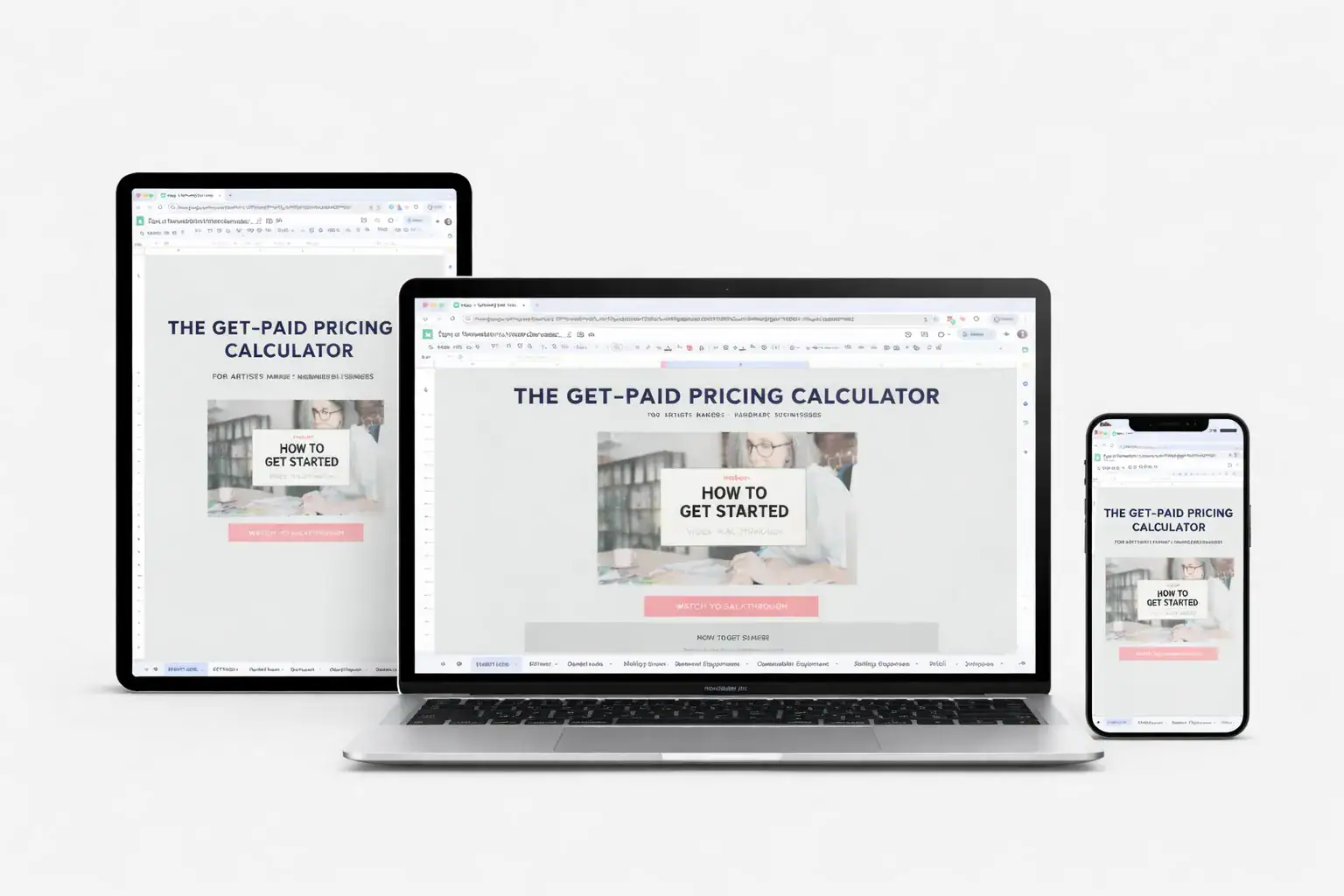
The Get-Paid Pricing Calculator will make this simple for you
If this all sounds really intimidating or time consuming and you want some help, get the Get-Paid Pricing Calculator will help you calculate your cost-plus price quickly and simply.
You put in your numbers and it will do the difficult calculations for you You won’t need to work out how to account for your overheads or selling costs. It’s all done for you.
And the video support will even help you to work out what is an overhead vs a selling cost so you don’t have to worry if you’re putting your expenses in the right places.