As makers and handmade business owners, we are just as affected by increases in the cost of raw materials as any other product business.
Whether it is a war, a strike, unseasonal weather, a blocked canal, or a lockdown – any time that the production or transportation of good is disrupted, prices go up.
And when prices go up, they usually go up for everyone, including our customers. So we have a tough decision to make.
Do we pass on the increased costs to customers in the form of a price increase, at a time when our customers might already be feeling the pinch? Or do we absorb the increased costs ourselves and take less profit from our business?
It’s not an easy choice. Raise your prices and you could make your work unaffordable for at least a portion of your audience, or maybe just less of a priority. Absorb the increase and you could end up losing money on each sale, especially if you’re not 100% sure of your numbers.
The important thing to remember is that decisions about pricing must be made with calculations and judgement, not with fear or a scarcity mindset.
Because every cost in your business is paid by someone. And if it’s not your customer, it’s you. When you absorb a cost increase, you are paying for it out of your own pocket, so you need to make that decision with your eyes open.
The real cost of absorbing it
When one of your materials goes up by a small amount, it can feel like it doesn’t matter much. It’s just a few pennies here and there.
But these small increases can add up when they are spread across all of your products, and when they affect more than one of your materials.
If you measure the effect across all of the products you sell in a year, you could be losing hundreds of pounds. And that money comes directly out of what you’re able to pay yourself.
Even when there are no geopolitical events causing a spike in raw materials, general levels of inflation means that your materials suppliers are probably raising their prices at least a little every year.
Absorbing them once might not be a big deal, but do it several years in a row and your profits get slowly eroded over time.
This comes out of the money that would go towards your pay, and means that your pay is going down as inflation goes up. So you end up with a lower wage, that buys less stuff than it used to.
Not great.
You have more options than you think
Absorbing a price increase might seem like the only option, or maybe just the default one, but there are actually a few different things you can do to mitigate the impact of the increase in costs.
It’s worth working through them all before you commit to anything.
Raise your prices.
This is the most direct response and, to be honest, it’s the best one. You maintain your margins and instead of you losing hundreds of pounds and taking a significant cut to your income, each of your customers pays a little more.
It’s also the best way to keep up with inflation. Inflation is the rate at which prices increase every year and it’s the reason why you might see a price increase every year from your suppliers. Passing these small price increases directly on to your customers makes the most sense, so you can maintain your profit margins
Change your product mix.
Are some of your products more affected than others? You might choose to promote the ones with healthier margins, or retire a product that no longer makes financial sense.
If you have a particular product range that is very affected by increases in the cost of certain raw materials then you could also consider making at least some products that utilise different materials.
For example, the price of precious metals often rises very quickly in a wide range of economic crises. This is because people put their money into gold to avoid losing money in investments and that drives up the price.
If you are a precious metals jeweller, you might consider making some ranges with materials that are less reactive in a financial downturn. These would provide you with some support when the price of gold or silver increases.
Reduce other costs.
Can you find savings elsewhere in your business that would offset at least some of the increase?
Sometimes there are savings to be made in labour that we haven’t considered. More efficient processes, a piece of machinery that can reduce the time spent, or making fewer trips to the post office by batching orders differently
Sometimes we can change the packaging or reduce some “nice to have” bonuses to find cost savings.
Find a different supplier.
It’s always worth checking whether the increase is specific to your supplier or industry-wide. Sometimes a quick search turns up a better option you hadn’t considered.
Absorb it, deliberately.
It’s still a valid choice to decide to absorb the cost of an increase in your raw materials, an increase in the cost of shipping, or an increase in your platform or payment processing fees.
But it should be one you make after looking at the numbers and understanding exactly what it will cost you over the next six to twelve months. That is very different from just assuming you have no choice but to take the hit.
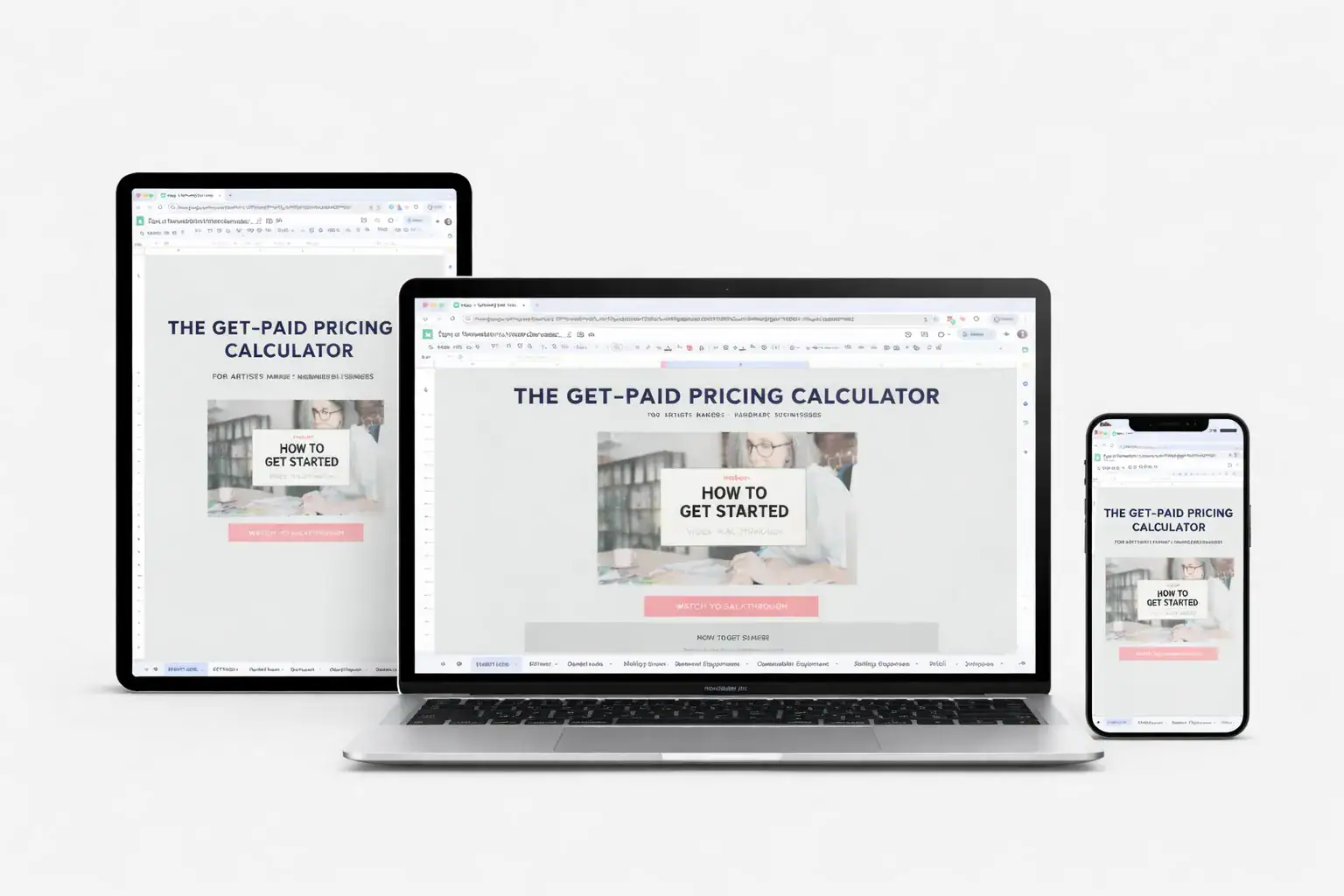
If you want to see exactly how a cost change affects your prices across your whole handmade product range, the Get Paid Pricing Calculator will show you. You put in your real numbers and it tells you where the money is going, how much any single cost is affecting your bottom line, and what your minimum price needs to be.
“My customers can’t afford more right now”
This is one of the most common reasons handmade business owners give for not raising their prices, and it’s completely understandable. You’re feeling the pinch yourself, so you assume your customers are too.
But the assumption that people cannot afford to pay any more or that they would not prioritise buying your work over something else, often comes from projecting your own financial situation onto your customers.
In reality, they may be in a completely different position. They may be choosing to spend on things they value, and your handmade work might be exactly that.
The only way to know is to try. Raise your prices on one product, or on new products, and see what actually happens. You might be surprised. And if some customers do drop away, that’s useful information too, because it tells you something about whether you’re reaching the right audience for the prices you need to charge.
Run the numbers first. Decide second.
The most important thing to do when costs change is sit down with your actual figures before you make any decision. Work out exactly what the increase means per product, per month, per quarter. See it in real terms.
When you can see the numbers clearly, the right decision tends to become obvious. Sometimes that’s a price increase. Sometimes it’s a change to your product range. Sometimes it’s absorbing the increase for now with a plan to revisit in three months.
The point is that you’re making that call based on what the numbers actually say, not on a gut feeling that things are getting more expensive.
And you’re separating the decision about what to do from how it will feel or whether it is possible.
There are always options. The job is to work through them with real figures, not with assumptions.
If you’ve been putting this off because you’re not sure where to start, the Get Paid Pricing Calculator covers every cost in your business, including the ones most free pricing calculators leave out: overheads, equipment, and selling costs. It gives you a clear minimum price for each product so you know exactly where you stand.