So you’ve carefully calculated your prices, ensuring all of your costs are included and that you’re being paid a fair wage and a reasonable profit.
But what happens when those prices feel far too high? What happens when they’re much higher than the prices charged by other makers at the fairs you attend, and in the shops you sell through?
Does it mean that your business won’t work? That no one will buy from you? Do you have to price lower to be able to make sales?
Not necessarily.
Of course, you should never make assumptions about what people will pay, especially if your work is distinctive.
For example, I frequently sold £300-500 pieces of artwork at shows where I was alongside very low priced products, including one time when I was next to a stand selling £1 lucky dips for mass produced costume jewellery.
If people can clearly see that you are different, it doesn’t matter what other people are charging.
But you may be right that the people currently buying from you (at these markets and in these shops) may not be prepared to pay the prices you need to charge in order to make a profit.
That does not mean that “the market won’t pay any more” because the entire available market of people who might buy from you is much larger than you might realise.
“The market won’t pay it” is usually about this market
When makers say “the market won’t pay any more,” they’re often drawing that conclusion from a very specific set of experiences.
Maybe they sell at a local craft fair where buyers are browsing casually and comparing prices across twenty stalls. Maybe they sell on a platform where the default sort is lowest price first. Maybe they’ve tested a price increase and seen their sales drop.
But none of these things are proof that your work is too expensive or “the market won’t pay it.”
All they prove is that the people you’re currently reaching, in the places you’re currently selling, have certain expectations about what things should cost.
And expectations about what things should cost are shaped far more by the context in which your work is being sold, than by any fixed idea of what a product like yours is worth.
The truth is that there is no single “market price” for a mug, or a vase or a painting.
Whenever you walk into a shop, you have an expectation about the prices you’re going to see.
Think about what you expect in terms of price when you go into Home Bargains vs Harrods, Liberty vs Lidl.
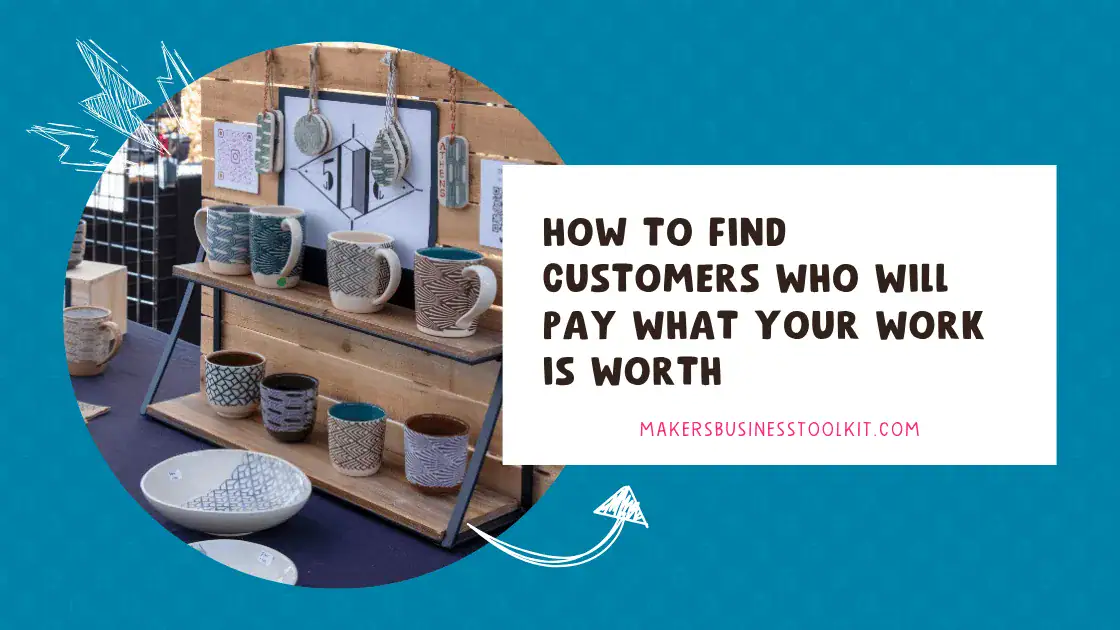
A beautifully made ceramic mug displayed on a trestle table in a school hall, next to mass-produced candles and second hand toys, is going to feel like a different product than the same mug displayed in a curated gallery or a high end interiors store.
The mug hasn’t changed. But the context has. And the customer’s perception of what it’s worth has.
So if you’ve been selling in environments where people expect low priced products, then raising your prices in that same environment is always going to be difficult.
The most effective way to deal with a customer base that either cannot or will not pay the price you need to charge is to change the customers and change the context.
That means finding a new audience with different expectations.
It’s a difficult thing to do.
There is the emotional impact of having worked hard to build an audience for your work and then realising that it’s the wrong audience and you have to start again.
And of course there is the practical and logistical work that needs to go in to finding a new audience, in ways that won’t be as easy or as comfortable for you.
It’s easy to put it off, or do it half-heartedly, secretly hoping that sales will just pick up and you won’t have to worry about it, but when your prices are too low, more sales won’t help.
My guide to pricing your handmade products explains the very real consequences of not seeking out an audience that can pay your prices.
In this post, we’re going to look at how to actually do it.
And if you haven’t worked out your profitable prices yet, start there. The Get Paid Pricing Calculator will show you exactly what you need to charge, including the costs most makers miss, so you know what number you’re working towards.
What the right customer looks like
The customer who will pay what your work is worth isn’t necessarily wealthier, although that is often the case.
Of course they have to have enough disposable income to be able to buy handcrafted products, at prices that are fair to the maker, and still have enough money left for the essentials.
But it’s not just about how much money they have. It’s far more about what they value.
They’re someone who values quality, craft, and individuality, and who is actively looking for those things.
They care about where something was made and how. They want to have a personal and often emotional connection to a product that feels special and well-made.
They are often buying gifts, or something meaningful for their home, and they’re willing to spend more because what they’re buying means more to them.
Sometimes they want their spending choices to reflect what they feel is important, using their purchases to make small changes to the things happening in the world.
These people do exist. They’re buying handmade work every day. There are enough of them to support any handmade business.
The question is whether they can find you.
How to start reaching them
It takes time and deliberate effort to build a new audience for your work.
It will definitely push you out of your comfort zone – especially if you feel like the people you’re trying to reach are quite different from you, in terms of income level or even how they present themselves in the world.
It will challenge you. But it’s necessary.
So let’s look at how you can get started.
Step 1: Get clear on who you’re looking for
Think about the best sales you’ve made so far. The ones where the customer didn’t think twice about the price, where they asked about your process, where they came back or told a friend.
- What did those people have in common?
- Where did they find you?
- What/who were they buying for?
- Where else do you think they shop?
- What do you think they do in their spare time?
Build a profile of your best customers so far and make that your starting point.
If you sell in person at all, pay close attention at your next event. Watch who stops, who picks things up, who asks questions.
Paying close attention to the customers who already value your work will tell you a lot about where to find more of them.
Step 2: Find out where people are already spending at or near your price level
Look at the shops, galleries, and online platforms that sell work around the price point you need to reach.
Look at the Instagram accounts, blogs, and publications that feature work around this price point.
Those are the spaces your ideal customer is already in. Make a list and study them.
Step 3: Put yourself in those spaces.
This might mean applying to a curated design market instead of a general craft fair.
It might mean getting your work into a gallery or a boutique that already attracts the right buyer.
It might mean joining an online platform where the audience expects to pay more for handmade work.
Or it might mean learning to pitch yourself to high end publications.
You may get rejected to start with, so start with one or two and then take any feedback that they give you on materials, presentation and branding so you can start to understand what their customer base is expecting.
Step 4: Make sure your presentation matches
Your product photography, your descriptions, your packaging, and your branding all send a strong signal to the buyer about the context in which you are offering your work. And remember it is mostly context that decides what your work is worth.
If your photos are quick snaps in your garden, or on a kitchen table, your buyer is going to assume a kitchen table price.
Before you put yourself in front of a new audience, make sure the way you present your work reflects the value you’re asking them to pay for it.
Step 5: Keep telling the story of your work
Never assume that anyone in your audience knows or remembers that your products are handmade, that you use specific materials, that you have ethical practices, or that each piece takes hours of skilled work.
You’re constantly gaining new followers who have never heard any of this before. Keep telling the story. Share it as a natural part of how you talk about your work online, because it matters to the customers most willing to pay extra for it.
Building a new audience is harder than lowering your prices
There’s no getting around that.
Finding a new audience takes months, sometimes longer. It means investing time in places where you don’t yet have traction. It means being patient when the results are slow to show.
And it means understanding that you will get some pushback from people who are not the right customers for you.
Lowering your prices avoids all of that.
It doesn’t require you to confront your beliefs about what your work is worth.
It doesn’t require you to have some days where you don’t make the sales you’re used to making.
And it doesn’t require you to make hearing “that’s too expensive” a part of your everyday experience.
Those things are difficult and there are lots of opportunities to retreat on your pricing.
There may be times when people say the things that you’re scared of hearing.
You might worry that your work is only for “rich people” now, and some people might even say that to you.
You might worry that people will think you’re greedy or “full of yourself,” and some people might even say that to you.
But the alternative is staying in the trap.
Because if you keep selling to the wrong audience at the wrong price, more sales will not fix the problem. You’ll just be working harder and losing more.
Every sale at an unprofitable price costs you money. And the longer you build an audience around prices that don’t work, the harder it becomes to change direction later.
Getting your pricing right is the first step. Finding the people who will pay those prices is how you build a business that can actually pay you an income.
If you want a straightforward overview of the key principles behind pricing handmade products, grab a copy of the free Handmade Pricing Cheat Sheet.
And if you’re ready to calculate exactly what your products need to cost, the Get Paid Pricing Calculator walks you through every cost, including the ones most makers forget.