You’ve been doing the work to market your handmade business. Posting on Instagram, sending emails, updating the shop, showing up at fairs, writing captions when you’d rather be making.
Maybe sales are slow, or inconsistent, or maybe they’re just okay, but none of it seems to be making any difference, and it’s starting to feel like all of the time you spend on marketing is just being wasted.
When this goes on for a few weeks, many makers start to wonder whether they’re doing something wrong.
Is there something they’re missing? Do they need to be on another platform? Do they need a new strategy? Do they need to do Reels, or Carousels, or Email Marketing or Webinars?
Or they start to wonder if they’re just not going to be able to build a business from this. Are their products good enough? Does anyone care about buying handmade products? Are they just rubbish at marketing?
More often than not, the answer is a lot simpler, but also hard to hear.
Your marketing is working. It’s just slow. And it hasn’t had enough time to show up in the numbers yet.
Sure, maybe there are things you can improve. Maybe you’re doing the right things, but not quite well enough and not quite strategically enough. But you get better at that by doing it more often and studying the results.
Stories of hitting the jackpot with one viral video or one influencer share have skewed our idea of what marketing is and how it works for 99% of us, 99% of the time.
Because marketing a handmade business, actually any business, is a long game, and most of us are trying to judge it on short timelines.
That mismatch between expectations and reality is what causes your lack of confidence in your marketing – not the marketing itself.
What “the long game” actually means
When it comes to your marketing, the returns you get this month are often the result of work you did months ago, and the work you do this week will mostly show up months from now.
Time and consistency are the things that make it work.
We get our content and/or our products seen by as many people as we can, and a small proportion of them (in some cases, a really small proportion) pay attention.
Then we have to get their attention more times, so that they know who we are and what we sell.
People buy when:
- They have had enough contact with you to be aware of you and trust you,
- When the right moment lines up in their life, and
- If you happen to be visible at that moment.
You can’t control when the right moment arrives for them. And can’t always predict it.
That’s why you need to be marketing all the time.
That ongoing, everyday marketing that feels pointless – that is the thing that’s building the trust and familiarity, and also ensuring you’re visible when they have a reason to buy.
That is the thing that is really difficult to get your head around when marketing a small business.
The sales that happen today are a reflection of what you did in the past. Today’s sale doesn’t come from today’s Reel.
It comes from today’s Reel, plus the email you sent six weeks before, plus the fair they met you at last autumn, plus the three times they saw your work on a friend’s feed without you knowing.
So when you’re trying to assess whether your marketing is “working” after three weeks of posting more often or more strategically, the answer is you can’t tell yet. Because you’re looking at the past.
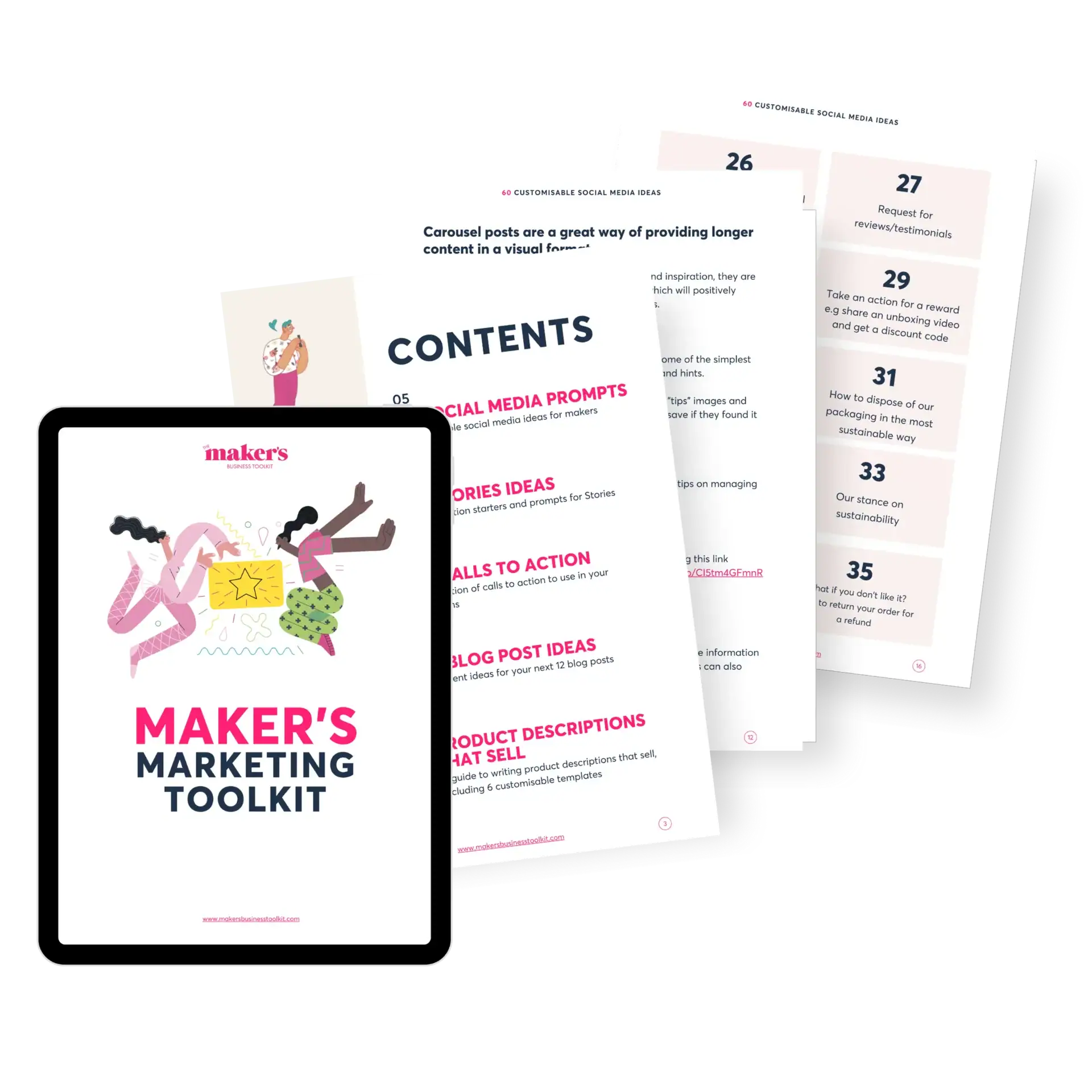
Maker’s Marketing Toolkit
With content ideas for social and blog posts, mix and match calls to action, and a repeatable framework for writing your product descriptions, this toolkit will help you to show up online with confidence and turn your followers into customers.
The three jobs your marketing has to do at once
One reason it’s hard to tell if marketing is working is that it’s doing more than one job at the same time, and the jobs all pay back at different speeds.
Any piece of marketing content you put out is doing some combination of three things:
- Reaching new people who have never heard of you.
- Staying in front of people who know you but aren’t ready to buy yet.
- Converting people who are ready to buy right now.
A new follower who found you through a Reel today might not buy for another year. Someone on your email list from a fair last May might open an email this month and finally click through. A customer who bought from you two Christmases ago might see your latest product and decide it would be the perfect present for their sister’s birthday next month.
If you only measure your marketing by considering today’s sales, you will miss most of what your marketing is doing. The other two jobs are where tomorrow’s sales come from.
And if your marketing has no strategy for reaching new people and staying in front of people who are aware but not ready to buy, then it’s not going to be as effective as it could be.
Strategic marketing feels repetitive (and maybe boring), but it’s supposed to.
When you get more strategic with your marketing, and you think more deliberately about all of the jobs it has to do, it can start to feel a little boring.
The same themes for your social media posts week after week. The same products mentioned in this month’s emails that you mentioned last month. The same three or four angles you return to.
It can make you feel a bit restless, and that’s when you can start to worry that it’s not working.
Maybe you wonder whether you should be doing something more impressive. Something new. Something that feels like it’s moving.
It’s more about how it feels to you than whether it’s actually doing its job. That’s why you can know that you need to give it more time, and yet still feel frustrated and sick of it.
But the person seeing your post today probably didn’t see the one you wrote three weeks ago. They didn’t read your previous email. They might have missed the one before that too. What feels repetitive to you is new information for them, because you are the only person in your audience who is reading everything you put out.
The art of marketing is saying the same things in different ways over and over again, so that the message lands, both with people who are paying attention and those who missed it the first 10 times you said it.
And there’s a reframe here.
If every post has to be a new concept, a new script, a new idea, the mental load of coming up with it all is exhausting.
A set of themes you can return to in different combinations reduces the thinking load and can actually make it easier to get done – if you can stop worrying that you’re missing something.
The traps that pull you off the long game
Knowing marketing is a long game doesn’t mean that it is easy to resist the urge to keep chasing dopamine by checking metrics and signing up for new marketing courses.
A few specific things often pull makers off course, meaning that they never get the chance to build up the momentum they need to make their marketing effective.
Platform hopping
When one platform feels dead, the temptation is to add another one. Maybe you just need to be in more places to find more people.
And when everyone starts talking about a new platform that “everyone is moving to” it can be really hard to stay the course with what you’re already doing.
The trouble with new platforms is that they come and go, and most don’t ever get the subscriber numbers to matter. Being a late adopter of a new platform doesn’t mean you’re “missing the boat.” It’s actually a smart strategy to avoid wasted time on an untested new platform.
Posting on too many platforms can spread your efforts too thin, unless you have a quick and simple way to cross-post to all of them at the same time.
Instead, pick the one or two platforms that you think are likely to be the best fit for your customers and commit to a posting strategy on those for a minimum of three to six months before you assess whether it’s working or not.
Chasing every trend
Trends are seductive because they feel urgent. If everyone is doing a certain type of Reel this month, it is hard to watch and not join in.
But there’s no point posting an AI-generated version of you as a Barbie doll unless you have a strategic way to make that about your products and your business.
The same goes for trending audio. If it gets you in front of 1 million people who have no interest in your work, it is actually damaging your reach on the platform instead of helping it.
Your posts need to be specifically designed for the right people to see, and they need to communicate the subjects and angles that actually sell your work.
That helps the platform know who to show your future posts to, and it helps those people know what is being offered.
Lots of views feed your ego. You can still feed your bank account with much smaller reach and lower engagement.
Ghosting when it feels flat
A really common trap is going silent when instant results aren’t happening. Sales are slow, so you email less. Engagement is down, so you post less.
But when you stop showing up, you lose all of the momentum you built up.
And because your marketing results are the outcome of what you did weeks ago, it can take some time before you see a drop-off in interest and sales.
That leads you to think that it wasn’t the marketing that was making the difference – until everything stops a few weeks later.
And then it’s hard to get things going again.
I’m a repeat social media ghoster. It’s always the thing I drop when I get overwhelmed, and I know from experience how much effort you have to put into getting things going again.
Posting three times a week every week is better (and less effort) than posting daily for a month and then ghosting for six. Trust me.
What a thoughtful marketing plan looks like
When you are running everything yourself, a marketing plan has to fit into actual life. That means it is small, focused, and repeatable.
A reasonable plan for a one-person handmade business might look like: 2-3 posts a week on one social platform where your customers actually spend time, a consistent time slot for sending emails to your list, and a few extra points of contact around bigger moments like a new collection or a fair.
That can often be enough, if you do it consistently. And automation and thoughtfully reusing existing content can speed things up.
Remember, social media is for exposure, and email marketing is for conversion. You use the social channels to find people, and you use email to actually sell to them.
So your marketing plan should look something like this.
- Find the two or three places where you have the best chance of initially reaching new customers for the least effort.
- Convert as many as you can to a place where you have the best chance of consistently reaching them (ie, somewhere not controlled by an algorithm – like email)
- Show up in those places often enough, and for long enough, to keep brand new people coming in, warm up existing people, make sales, and encourage repeat buying.
How to tell if it’s working when the timeline is long
We all like to get some signals that we’re not just wasting our time shouting into the void, but how can we get those when sales today aren’t a reliable measure of whether our plans are working?
Instead, you can watch leading indicators, which are the signs that your marketing is working, and that you’re making it more likely that sales will eventually follow.
Some leading indicators worth watching:
- New email subscribers, week on week
- Replies to your emails or DMs in response to a post
- Repeat visitors to your shop.
- Messages from customers referencing something you shared weeks ago
- Direct search traffic (people typing your business name into Google)
Lagging indicators (the ones that move later) are sales, conversion rate, and average order value.
Those are still important, but if you only watch them, you could give up on marketing that is working, just before it starts paying off.
A good habit: pick two leading indicators and track them monthly. Watch the direction of travel over a quarter. If they are moving in the right direction, the sales often follow.
And knowing the leading indicators you are trying to improve can help you to be more proactive in prompting people to take these actions in both your emails and your social media posts.
For example, asking people to reply to your emails or reminding people to subscribe to your email list.
Making these indicators the focus of your marketing efforts most of the time (rather than sales), can help you to play the long game better.
The long game is the whole game.
The makers who are growing their sales and customer base for their handmade businesses are usually doing something fairly ordinary.
A few focused messages, repeated in the right places, for a long time.
There’s no secret strategy. No viral moment. Just a loyal audience of customers that is much smaller than you might think, built by showing up and talking about what they have for sale.
It is slower than you want and less exciting than the content you see online. But it works, and it translates into real sales.
If you have been marketing inconsistently because you can’t work out what to say or where to put your energy, the Maker’s Marketing Toolkit was made to help you with that.
It gives you repeatable themes to rotate through so your marketing has structure, instead of starting from zero every week.