
There’s this feeling that a lot of makers know too well. It’s the sense that no matter how hard you work or how much you get done, somehow you always feel behind.
Behind where you should be. Behind where you want to be. Behind where everyone else is.
And, worst of all, behind in the calendar.
You finish one busy period, catch your breath, and then suddenly you’re racing to catch up to the next thing.
Christmas runs into Valentine’s, which runs into Easter and Mother’s Day, which runs into summer fair season, which runs into Christmas again.
You never feel like you’re doing things properly – every seasonal event is just a last minute “do-what-you-can” situation.
And somewhere in the middle of it all, you wonder: when does this get easier?
I know from painful experience, that it gets easier when you start making better use of the quiet times. And as much as it seems like running your handmade business is one big scramble, there are times when sales are quiet and customers just aren’t particularly easy to sell to.
And most of us don’t make the most of those times.
Why?
Because they feel uncomfortable.
You finally have space to work on your business, but the work that needs doing is hard to conceptualise. It’s strategic. It’s overwhelming. It’s hard to pick just one thing.
So instead of tackling it, you find other things to do.
That’s the trap that keeps you feeling behind and it is a pattern that is surprisingly difficult to break.
Why The Quiet Times Feel So Uncomfortable
When we finish a busy seasonal period like Christmas and we finally have a bit of space to breathe and work on our business, it should feel good.
But it doesn’t
Why? Because we’ve got used to reacting and now we’ve got nothing to react to.
Through the busy periods our daily activities are dominated by stuff happening. There are orders and questions and deadlines.
When that goes away, we have to decide what to do with this precious period of available time for working on our business.
There are so many options. So much pressure to pick the “right” thing, to make sure the opportunity is not “wasted.”
It’s overwhelming just to figure out what to do, and when to do it.
So you find other things to do. And before you know it the busy period hits again.
The feeling of always being behind doesn’t come from scrambling in the busy periods. It comes from not making things better during the quiet ones.
And that usually happens because we fall into a familiar pattern of avoiding important work because it feels difficult or risky.
Two Ways You Might Avoid the Important Work
Here are two ways you might unknowingly sabotage yourself in the quiet periods.
A big distraction project.
You might suddenly decide that you really can’t make enough progress in your business without changing something big.
Redesigning your website. Completely redecorating your studio. Rebranding. Moving your email list or online store from one platform to another.
This feels strategic. It might even feel like fixing a problem that’s been blocking you. But is it really the most impactful thing to be working on right now?
The more seasonal your business is – and therefore the longer the quiet times are – the more vulnerable you are to this. And it’s super sneaky because it feels like you’re making real progress – when you’re actually avoiding it.
And I know this one personally because this is my favourite flavour of self-sabotage in my own business, and I’ve fallen into the trap more times than I’d like to admit.
The fiddly busywork.
This is when you find yourself focused on weird details that suddenly become intensely annoying or distracting.
It might look like spending a ton of time finding a complex workaround to fix that one page on your website that doesn’t display the font properly. Or changing your web hosting company because they raised their prices. Or spending too much time giving detailed feedback on that one feature you wish your online store had, but doesn’t.
It’s the small annoyances that you just can’t let go and that end up taking more time than you anticipate.
I know that many people struggle with this because I get a fair few messages during the quiet periods giving feedback on my grammar, the length of my sales pages or how much I swear in my emails. No one has time for that when they’re busy.
Whether you get into a big distraction project or lots of fiddly annoyances the similarities between these two approaches is clear.
You feel the discomfort and you try to fix that feeling – rather than plugging the holes in your business foundations.
So what should you actually be doing?
It depends on what your business (and you) most need right now.
Do you need growth or do you need to strengthen what you already have?
There’s an exercise I run in my Your Best Year workshop every January. I ask makers to think about the year ahead and decide: does this feel like a year for expanding or a year for deepening?
Expanding is about growth. New products. More visibility. Bigger sales. New markets. It’s exciting and energising, but it can eventually make a bit of a mess because you’re so focused on moving forward that you don’t have time to keep things tidy and running smoothly behind the scenes.
Deepening is about strengthening what you already have. Setting up systems. Learning new skills. Refining your processes. Expanding existing relationships. Reflecting on what’s working and what isn’t. Deepening years are less sexy than growth years, but they’re just as important.
Quiet seasons can be used for either type of work – but they are absolutely brilliant for the deepening work because this kind of work can help to make your business run more efficiently and give you a little more breathing room in the busier seasons.
That time saved can mean more time available for marketing, or just making the busy season less stressful. That usually leads to better results and less pressure, and the cycle switches from “always behind” to “always getting better”
Strategic Projects for the Quiet Season
Here are five projects worth your quiet season time:
Research your input costs and recalculate your prices
Quiet season is the perfect time to go through your suppliers, check current prices for your most-used materials, and consider raising prices.
You might find your margins have been slowly eroding over the last year, or that you have been omitting some important business costs.
Struggling to meet demand is also often a pricing issue so if you’ve been really stretched to fulfil your orders, it may be time to raise prices to reduce the pressure.
This isn’t exciting work. But it’s the kind of work that protects your business from slowly becoming unsustainable. And a more profitable business, with higher prices, means less stress and overwhelm for you.
Create a sales page for your commissions or workshops
More easily filling your commission slots or the spaces in your workshops means that you have more time to work on other things.
A sales page can do the heavy lifting on bringing people up to speed on what to expect, helping them imagine what it would be like, and answering all of their questions – meaning you’re not starting from scratch with every new enquiry.
And this page works for you 24/7. When someone asks about commissions or workshops, you send them the link. When you’re busy and can’t take new work, or your workshops are full the page says so. When you’ve got availability, you can share it.
It saves you time, makes you look professional, and means potential customers can get what they need to make a decision, without you doing any more work.
Set up a content library or batching system for your marketing
Instead of scrambling to post something every few days, use quiet time to create some time-saving assets for your marketing.
A content library with a selection of repeatable posts will make it so much easier to fill your weekly social media calendar.
Keep several versions of captions to introduce yourself and your business, and also to talk about each one of your products.
Try looking for different reasons people buy your products or different questions they have and make a short caption for each one. Then mix and match with different photos and you can easily repeat these posts relatively frequently.
You could also keep a vault of video content that you can use for Reels – just add different text and music each time and it will be fresh enough to recycle.
Having a ready-made library that you can pull two posts a week from will dramatically reduce the amount of time it takes you to produce social media content each week.
And adding a system for batching content creation will make this even more effective. This might mean setting some time aside to record short video clips of your products that can be used for Reels or cut together with other clips for a longer video.
It might mean taking a variety of photos of each of your products so you can post them more often without everything looking the same.
Or it might mean writing a few emails right now so that you can send them over the next few months without having to write something each month.
Everything you do to create reusable resources for your marketing makes it easier to be consistent with what you post – even in the busy times.
Work out what needs to happen to hit your income goals
Sit down with your actual numbers and reverse-engineer your income goals. How many of each product would you need to sell each month to hit the income you want? Are you physically capable of making that many? How long does each product actually take to make?
You might discover that your bestselling product takes so long to make that you’d need to work 60-hour weeks to hit your income goals. Or that making so many variations and options for each product is making cashflow hard, without adding enough sales to make it worth it. Or you might find that you need to add a product that you only need to make once (like a course or digital download) in order to support your higher workload products.
Doing this work tells you whether your current product mix actually supports the business you want, or whether something needs to change. That saves you from wasted time pursuing products that won’t give you the income you want – even if they sound good on paper.
Create work routines with checklists for repetitive tasks
Pick one repetitive task in your business (packing orders, preparing for markets, photographing products, whatever you do regularly) and create a checklist for it.
Add links to any content or software you use regularly, so that you don’t need to keep looking it up
This sounds too simple to make a difference. But checklists mean you don’t have to think in order to get the work done. They make it easier to delegate. They stop you forgetting steps when you’re tired or rushed. They make it faster and less tiring to do the everyday stuff that can take a lot longer than it should.
Start with one checklist. Then add more as you need them. Each one saves you time and brain power that can go to other things.
Which One Do You Need Most?
You could do any of these five projects. But you can’t work on all of them at once, so what is the priority for your business?
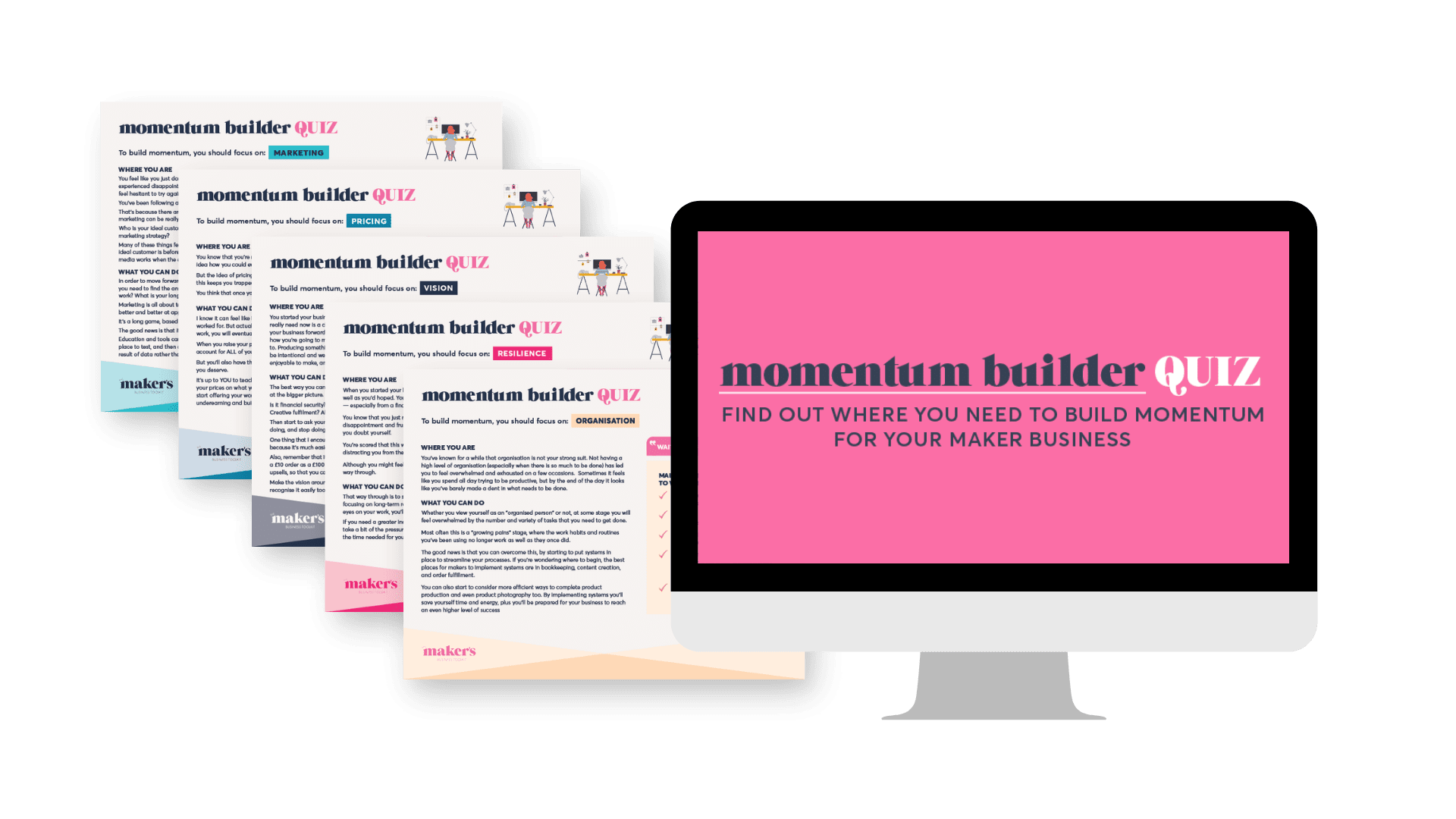
Take the Momentum Builder Quiz to find out which area of your business needs your attention most right now. It takes two minutes and gives you a clear starting point for your quiet season work.
The way to stop feeling always behind is to make the best use of the quiet seasons. And the way to make the best use of the quiet seasons is to complete at least one project that saves you time on an ongoing basis. Complete the quiz and pick the best one for you!