Writing product descriptions is one of those bits of running a handmade business that almost everyone hopes won’t matter very much.
It’s hard work. It’s writing about your own stuff, which is uncomfortable, and trying to sell without sounding like you’re selling.
You know the line and a half currently on your listing isn’t really good enough, but it feels like a real slog to write anything better.
So you leave it as “Hand-thrown stoneware bowl. 14cm. Glazed in oatmeal” and hope for the best.
And it’s not just product descriptions. Product photography gets the same treatment. So does your About page.
The customer-facing work that needs real thinking tends to be the bit that doesn’t get done, or gets filed for later, with the hope that maybe it doesn’t really matter for now.
It does, though.
And although writing good product descriptions doesn’t feel like a particularly good use of your time when there is social media to be done and fairs and shows to organise, this is actually one activity where a bit of time spent now can lead to more money going forward, without you needing to find more customers than you already have.
Marketing a handmade business takes a long time. The makers who grow are the ones who keep showing up with a plan and let small, steady moves keep building into a sustainable business, instead of chasing one shiny object after another.
Product descriptions are a really great place to invest your time in doing that work.
They’re unglamorous, but once you’ve written a good one, it keeps working long after you’ve moved on to other tasks. They’re also, for most makers, a really cheap sales boost, because they squeeze more revenue out of the traffic you already have.
And learning to write this kind of text well means that you get better at writing about your products everywhere, including your more direct marketing, like social media and email.
Knowing how to write a quick paragraph about what your product is, who it’s for, and why they would want it is useful in so many places and will save you a lot of time in the long run.
So today I want to take some time to talk about what makes a product description effective, and how to write one without defaulting to process and materials because you don’t know what else to write about.
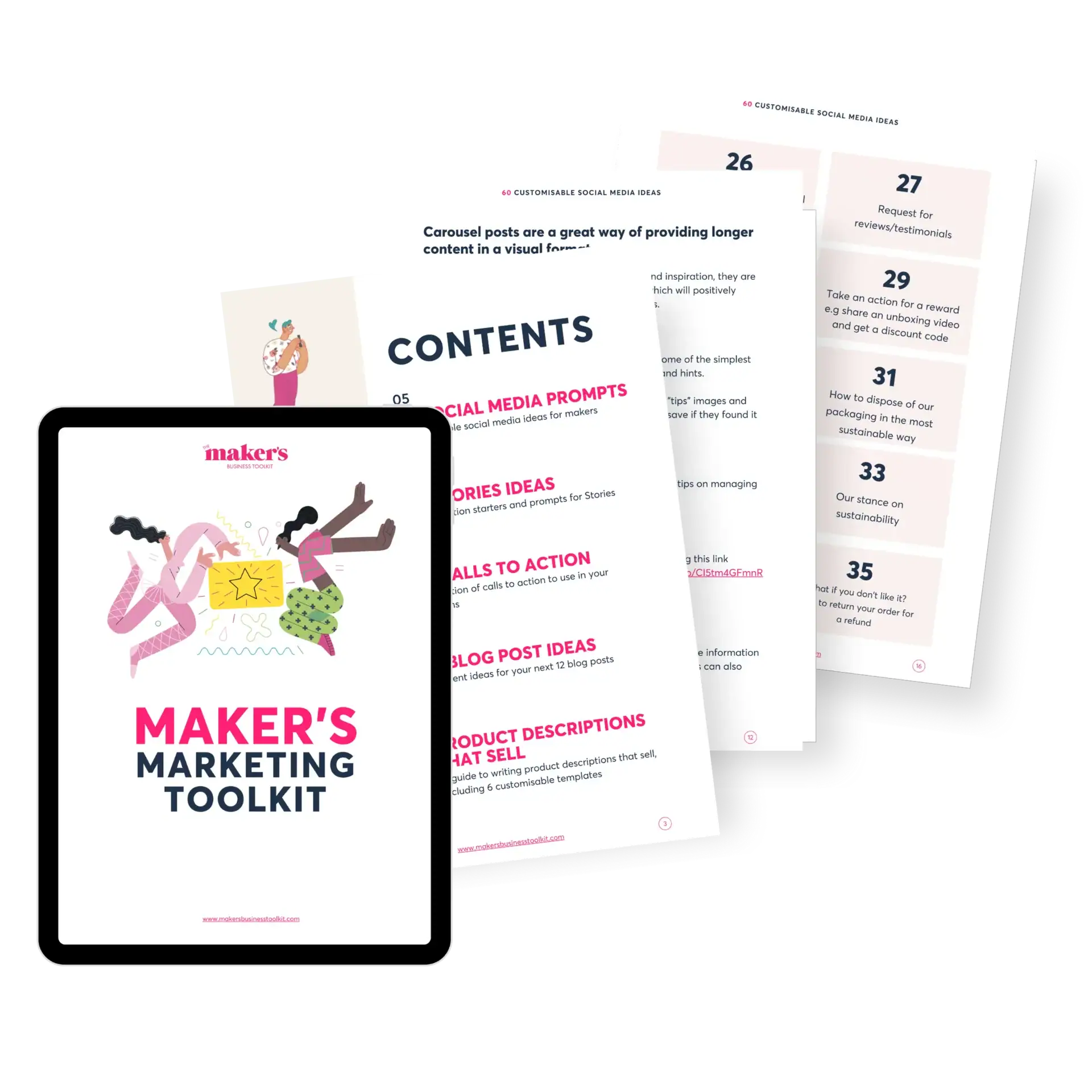
Maker’s Marketing Toolkit
With content ideas for social and blog posts, mix and match calls to action, and a repeatable framework for writing your product descriptions, this toolkit will help you to show up online with confidence and turn your followers into customers.
What makes a bad product description
When product descriptions are bad, it’s often because vital context is missing. The buyer is just being asked to do too much work to figure out whether this is something they want, how it will make them feel, and how they can use, gift, wear or display it.
And when people are asked to do too much work to decide if they want something, they’re probably going to decide to think about it later. That’s not good for your chances of making a sale to them.
These are some of the most common mistakes in handmade product descriptions.
They’re too short.
A few words might be fine on a craft fair label, where the buyer is standing in front of the piece. But online, they can’t pick it up, and can’t see how it sits next to other things. They often can’t even tell how big it actually is.
Short product descriptions assume that the buyer knows more than they do, and that means they have to do quite a lot of work to figure out what it is, and whether they want it.
They’re features-only.
A list of materials, dimensions, and/or process details reads more like a database entry than a product description. These are also often heavy with jargon, describing techniques or details of the making that the customer may not understand.
If you’re going to include a term like raku, or intaglio, or even giclee, it needs to be explained in plain English so that people who love the piece aren’t turned off by feeling uninformed.
Features and process are still important, and you’ll want to include them as the basis of a much longer product description that helps the buyer to see themselves owning, wearing, gifting or displaying this piece.
But if you present the information as just a few datapoints, rather than a conversation about what makes the piece special, you have to expect that your customer will be unengaged and unexcited.
They’re written from the maker’s perspective.
The story of how you discovered this glaze, or your love of slow craft, or the hours you put into each piece, is important to your brand and maker origin story. But it’s not what a buyer is immediately concerned with when they’re deciding whether to add this to their cart.
Their decision-making is much more about themselves. They’re asking whether this particular piece fits into their particular life. Do they want it? Do they need it?
Those questions aren’t answered by how you discovered a glaze, but they are answered by how the glaze transforms the piece and the experience of owning, using or displaying it.
What buyers actually want to know before they hit buy
When someone is reading a product description on your site, they’re trying to answer a small set of questions, mostly without realising it. Good descriptions answer them so that the buyer doesn’t have to do any work.
They can easily tell if they want this, with their kids screaming from the other room and 30 seconds left on the timer before dinner is ready.
Here’s what they want to know.
What is this, and what is it for?
A bowl isn’t just a bowl. Is it a bowl for cereal, a bowl for centrepiece fruit, a bowl that’s mostly going to live on a shelf and look beautiful? Help the buyer place it. How are they going to use it?
How big is it, in something they can picture?
When you write “14cm diameter”, the reader’s brain immediately goes looking for something it knows that is the same or similar size. That’s unnecessary work for them to do, and if their brain works in imperial measures, it’s even harder. You can do the work instead and make it easy for them.
“Holds a generous portion of porridge. Sits comfortably in one hand.” That’s a size they can immediately understand without any mental gymnastics.
What does it look, feel, and sound like?
Sensory detail can help to replicate the experience that in-person buyers get from picking something up. Online buyers don’t get that context as standard, just by touching something, so we have to fill in the gaps for them.
Smooth or textured. Matte, or with a satin sheen. Light, or surprisingly weighty.
And remember that your product text is describing an experience, not just listing descriptive words.
This isn’t easy, but if it’s hard work for us to think about how to describe these things, that means it’s hard work for our customers to imagine it too. And that’s a barrier to making a sale.
Who is this for? And for what occasions?
This helps people to understand the emotional benefit they will get from the product by picturing themselves using it.
That means specific situations. Hosting a dinner party. Giving the perfect wedding gift. Enjoying a mindful morning ritual.
It doesn’t have to be detailed, and we can include more than one when our products have a broader appeal.
Our customers aren’t expecting to read something exclusive to their specific likes and dislikes; the important thing is that we’re providing a mental shortcut that will help our best customers to see themselves in at least one scenario.
What do they need to do to look after it?
Can it go in the dishwasher, or does it need to be hand-washed? How should we store earrings between wears, or should we take them out at night or when showering? Can the print sit in direct sunlight or a humid environment?
Buyers are concerned about wasting their money. They’re worried about buying something too fragile for use, or about doing something silly to damage a valuable purchase.
A little bit of reassurance and help to avoid making a mistake that wastes their money removes yet another bit of mental work.
Where your story fits, and where it doesn’t
Even though your product descriptions should always be written for a buyer’s needs, that doesn’t mean that your story and your personality should be totally absent.
Your buyer is choosing to purchase a handmade product when there are most likely some mass-produced, cheaper alternatives available to them.
They made that decision for a reason.
It’s still about them and how they want to feel (rather than about you), but connecting with the maker’s inspiration, creative process, and artistic choices is a part of that feeling.
A line about why you chose this particular glaze, and what it adds to the piece, or how this piece is part of a series exploring a coastline you grew up on, can really help to connect the object to a feeling, which is what most people are actually buying when they buy a handmade product.
They don’t usually get that connection from stories about how you’ve always loved drawing or how you’ve evolved your techniques.
The general rule: your personal story, and the story of the development of your craft, belongs on your About page. And (briefly) in your welcome email, and in your social content.
In a product description, it’s there only to serve the buyer’s decision. Because a product description is about the sale.
How to write descriptions like this every time
Writing product descriptions is hard. We’re taking away the work that our customers would have to do to figure out if our products are right for them, and we’re doing it ourselves.
That’s not easy. Working out how to elegantly point out the benefits of a piece, or how it might fit into a buyer’s life, is where so many of us get stuck staring at a flashing cursor.
That’s why I included six product description templates, along with a full guide to “Product Descriptions that Sell” inside the Maker’s Marketing Toolkit.
The guide walks you through who you’re writing for, then gives you a tested structure that works across every product in your shop, plus six templates (wall art, jewellery, clothing, bath and body, and more) so you can see exactly how to use it on what you sell.
The Maker’s Marketing Toolkit also includes 60 social post ideas, 12 blog prompts, and 20 ready-to-use CTAs, so the rest of your marketing gets some love as well.