There is no shortage of online advice about marketing for artists and makers.
Be on this new platform. Post at this specific time. Do short-form video. Make B-roll. Start a newsletter. Write a blog.
And, more often than not, jump on this new trend/strategy/thing that everyone is doing before you miss it.
It seems to me that this constantly changing, fomo-inducing, jackpot-chasing guidance isn’t good for our wellbeing. And it’s not even all that helpful for making sales.
It’s often derived from marketing strategies for much bigger businesses. Those with a team, a budget and all day to spend on marketing. Not a one-person handmade business, where you are making the thing, photographing it, posting about it, packing orders and answering questions, all at once.
But the more important reason it’s not helpful is that it’s not joined-up advice. It’s fragmented.
Little pieces of the picture. Little tactics and tricks. But no overall vision for what you’re trying to do, besides just make sales now.
So it’s no wonder marketing can feel confusing and overwhelming. A lot of makers end up doing a bit of everything, or almost nothing at all, because they can’t tell what actually matters and they don’t know why they’re doing something or what they want to achieve.
But underneath all the noise, marketing is simpler than it seems. It’s a strategy with just three simple aims:
- Get the attention of the right people
- Convert those interested people into buyers
- Convert those buyers into long-term customers and fans.
Every tactic you’ve ever been told you have to do is just serving one of these three aims.
The problem is that when you don’t know which one, and you don’t have a plan for how you’re going to do all three, you’re not actually in control of your marketing.
You can’t measure it, so you go on gut feel rather than actual data. You can’t do more of what’s working because you don’t know why it’s working. And you can’t separate the things that could really help from the noise that’s just designed to keep you on the platforms so you can see more adverts for more marketing courses.
Once you stop thinking of your marketing as a hundred separate, equally important jobs and start concentrating on how you will attract, nurture and convert customers, it becomes something you can get your head around.
So let’s go through the big picture. What marketing is really for, how you get attention, how you turn that attention into sales, and how you keep it going, without it taking over your life.
What marketing actually is
Before you get started with any of the tasks you need to do, it really helps to be clear about what marketing is and what you’re trying to achieve with it.
Because marketing isn’t posting on Instagram. It isn’t having a website. It isn’t sending the odd email when you remember. Those are all things you might do as part of your marketing, but a plan for marketing your handmade business needs to start from the big picture.
Marketing is everything you do to get the right people to notice your work, want it, and buy it. And then to come back and buy again.
That breaks into three separate aims.
The first one is getting attention. Getting your work seen by people who would love it, so that a steady stream of the right people know you and your products exist.
The second one is turning that attention into sales. Taking the people who’ve noticed you and helping them become customers.
And the third is turning sales into a deeper relationship. Encouraging customers to become repeat buyers and fans.
Every job that you do is trying to achieve one of these three aims. A Reel is usually about getting attention. An email reminding people that a sale ends on Friday is about turning attention into a sale. A craft fair might do both at once. When you know which aim a piece of marketing is serving, you can do it much more strategically, or even decide to stop doing it.
You don’t need to be loud, pushy, salesy or even a natural in front of the camera. You don’t have to be on camera. You don’t have to do any of the tactics put in front of you.
As long as you have a plan for attracting people, converting them into buyers and then nurturing them into repeat buyers and fans, you have a path you can follow and test. And crucially, you can get better at it with practice.
Start by knowing who your work is for
A really important starting point for all of this is having a good idea of who your work is for.
It’s tempting to be passive about this, deciding that art sells itself to whoever is interested. But keeping your target audience very broad actually makes everything harder down the line.
Who are you trying to reach? What do you say to them? Where do you find them? You can’t answer any of that until you’ve got an idea of who you’re talking to.
Think of it this way. Have you ever had to buy a gift for someone you didn’t really know at all?
It’s difficult, isn’t it? Everything you think of comes with doubt, and even the safe choices seem like a risk. What if they don’t like white chocolate or don’t drink alcohol? What if they’ve got sensitive skin or avoid sugar? What if they hate the smell of lavender?
But when you know at least a bit about someone, it’s easier to find the things that will appeal to them.
It’s the same with your customers.
The more detailed your customer profile, the easier it is to create marketing content that will appeal to them. It’s easier to get their attention and answer their questions.
If you don’t have much to go on, remember that you just need a real, honest picture of the people most likely to buy and love your work.
Think about the customers you already have. The ones who came back. The ones who told a friend. The ones who didn’t ask for a discount.
What do they have in common? What did they say about why they liked your work? What did they use your work for, a gift, a treat, a particular room in their house, a way to mark an occasion? What do they care about? Supporting a small maker, owning something no one else has, knowing how it was made?
The better you understand those people and what they want when they buy from you, the easier everything else becomes. Because you can make decisions more confidently when you’re talking to someone specific.
Getting attention: getting the right people to notice you
So part one of the strategy is getting attention. Actual eyeballs on your work. This means getting seen by the right people often enough that they start to notice and remember you.
There are two elements to this: having something worth paying attention to, and showing up in the places those people already are.
How you present your work
Getting attention starts with presentation. When someone comes across your work for the first time, scrolling past on their phone or walking past your table at a fair, you have about two seconds. Attention-grabbing presentation is what makes them stop in those two seconds instead of carrying on.
A big part of that is your product photography. A flat shot of your product on a white background, or a quick snap on your kitchen table, is never going to grab attention like a good lifestyle photo that shows them what it would be like to own it.
The mug on the type of table they’d love to have in their kitchen. The print on a real wall in a beautifully decorated room. The scarf or the earrings actually being worn. Photos like that create desire, because people can picture your work in their own life instead of just looking at it.
This is where knowing just a bit about your most likely buyers makes life a lot easier.
The same goes for your stand at a fair or a market. Your first job is to get attention, so consider how you will attract people from across the room to your stand. Large, attention-grabbing pieces, or display boards with product photographs, allow people to notice you and will make the right people want to come and have a proper look.
Whether it’s a photo or your stand display, in those first couple of seconds, someone needs to be able to tell what your work is and roughly who it’s for. If they can’t, you haven’t earned their attention and even the right people will scroll on or walk on
The channels that bring new people in
If you don’t have a plan for your marketing, you can end up trying to be everywhere all at once, which is a recipe for burnout.
But when you recognise that different marketing channels can take on different roles in your marketing, you can start to be more choosy and more strategic about where you show up.
And some marketing channels are really good for getting the attention of new people.
Social Media
Social media is great for this. It’s where new people trip over your work while they’re scrolling, and where you stay familiar to the ones already following you.
You don’t need to be on every social media platform. Pick the one or two where you can reach the largest number of people likely to respond well to your work, with the least investment of time or money.
Press, PR and Influencer Marketing
Press coverage, PR and influencer marketing are also good for introducing your work to new people. Again, when searching for opportunities, consider how aligned the publication or influencer is with your particular target audience and also the number of people you could reach, relative to the cost.
In-person events
You will always get more attention in person than you do online. People are just more engaged and more willing to spend the time to learn about your work when they’re standing in front of you.
Craft fairs, Open Studios, Festivals, Fan Conventions, Agricultural Shows and Street Markets can be excellent for growing the number of people who are aware of your work.
Just remember that it’s not the total footfall that matters. It’s the number of people who are likely buyers for your work. And if you want more sustainable sales, you need a deliberate strategy to capture this attention and get the interested people to join your mailing list.
Shops and Galleries
Having your work stocked in shops and galleries is a way for you to generate attention much more passively. While you are working on other things, your stockists are working to introduce your work to a wider audience.
Be sure to retain as much of your original branding as you can, so that buyers can find you later, while still respecting that these are the store’s customers and you should not try to directly compete with your own stockists.
Attention adds up over time
There’s one important thing to remember about attention that will stop you from giving up too soon. Attention is cumulative. It adds up over time.
Depending on when and where they come across your work, people probably won’t buy the first time they see you.
That’s why consistency matters more than any single post going big, or any individual tactic.
You’re not trying to go viral. You’re trying to be seen, again and again, by the right people, getting enough of their attention until they are aware of you and are ready to take the next step, which might be buying or might be signing up for emails.
It’s really common to underestimate the amount of attention you need to get, and to overestimate how much people are noticing or paying attention to the content you create.
So if you’ve ever felt like your marketing isn’t working, it’s often just that not enough people have seen your work enough times yet, and there’s more on why that happens here.
Turning attention into sales
Getting attention is only half the job. Once we’ve got attention, we have to convert it into sales. And this is where so many makers are leaving money on the table and not selling as much as they could.
Conversion isn’t about changing the colour of a button on your website or having perfect branding.
Conversion is about answering questions, helping people to understand what’s on offer, what it can do for them, and making it easy for them to choose to spend their money with you.
It’s the part that a lot of us are uncomfortable with, but it doesn’t have to be pushy or boastful.
Convincing people to buy from you can be as simple as giving them all of the information they need to be able to decide whether it’s right for them or not.
But before you can even start to warm up and convert more and more of your audience, you need to have a more consistent place to communicate with them
Capture the attention you’re earning
Social media might be great for attention, but it’s not great for conversion. That’s because the attention you get is inconsistent, so it can be hard to convert the people who need more than one point of contact with you.
You can’t be sure that the person who interacted with your content today, will see it again tomorrow, or next week, or next month.
The algorithm decides who sees your posts, and the rules change all the time. What works today may not work tomorrow. Not to mention the risk of getting your account hacked or shut down and losing access to your audience overnight.
So, for both conversion and safety, it’s important to move the people who notice you to a place where you have more control over the experience.
In almost every case, that means an email list.
Email is perfect for the conversion part of marketing because it is controlled by permission, not an algorithm.
People raise their hand to say that they want to hear from you. They get those messages in a space where they’re not distracted by the brain rot and rage bait of social media, and they often see all of your messages – not just the ones the algorithm chooses.
In our inboxes, things are calmer. And we’re used to being sold to there.
So everywhere you get attention, invite people onto your list. Put it in your Instagram bio. Mention it in your posts. Collect email addresses at every fair. Your list is the bridge between attention and sales, and that makes it the most important piece of your marketing.
Build trust and stay in front of people
Once you’ve been in business a while, finding new people to show your work to is not your biggest opportunity for making sales more easily.
It’s converting the people who already know and like your work but are hesitating on buying, for some reason.
You’ve done the work to get their attention, and now you need a group of repeatable marketing messages that can help turn people who have doubts, into people ready to buy from you now.
Every person who buys your work has a different reason why it matters to them. Your job is to talk to their reason, answer their questions, and share the things they need to know
That is what “messaging” is all about. It’s what you say in your marketing. Because there’s a difference between showing something and making people want it.
But what makes any given person buy? It’s different for everyone.
Take a plain wool jumper. One person might buy it because of its comfort, another because you used recycled wool, another to give it as a gift, and another because they want something to last a long time.
If you want to sell to them all, then you need to use different angles in your marketing.
We call these “messaging angles” – because each person needs to hear a different type of message.
A messaging angle is simply the main idea or argument behind a piece of marketing. It’s how you’re choosing to talk about the product so that you can “sell” it to a specific person.
The more messaging angles you can identify for your work, the easier it becomes to create interesting marketing without feeling like you’re repeating yourself.
And you also maximise your sales, because your messages stack on top of each other to make your work easy to buy.
And if you need help with finding your own messaging, check out Find Your Angles. It will identify 20 marketing messages for your specific business and products that you can use to generate content for years.
Make sure you are actually asking for the sale
Here’s where a lot of makers fall down. They get attention, they build a warm audience, and then they never actually ask anyone to buy. They post around their work, they chat about studio life, they’re useful and friendly, and they hope people will click through and buy on their own.
But if you never make a clear offer, most people won’t buy. They might want your work, but they need you to make it easy. They need you to tell them it’s there, to say it’s the last week to order in time for Christmas, to point them to exactly where they can get it.
You HAVE to tell people how to buy your work if you want your marketing to be effective. And it doesn’t have to be pushy at all. You can be “salesy” and when it’s done the right way customers actually appreciate it.
Turning buyers into repeat buyers and fans
The last of the three jobs for your marketing is to turn buyers into repeat buyers and fans.
Selling again to someone who has already bought from you is far easier than finding a brand new customer.
They know what to expect from you, and that goes a long way to overcoming some of those worries that typically hold back a new buyer.
And when customers tell their friends and family about you, that’s an additional engine for getting attention that keeps the whole system growing.
Follow up, and sell again
This is where you can use different marketing messages to help people who’ve bought from you before feel great about their purchases and be able to share them with other people.
Stories about the ideas behind your work, about your ethics and values, and little personal snippets about yourself and your process help your buyers to feel like they made the right choice in buying from you.
It also makes it easier for them to be able to talk about you (and the piece that they bought) to other people if they know some of the story behind how and why it was created.
A personal recommendation means that the new people have fewer worries, fewer concerns and more knowledge about you before you even start to share the marketing messages designed to nurture them.
So keep talking to the people who have bought from you. Thank them, tell them what’s new, invite them back. A customer who loves your work, is willing to buy it repeatedly, and tells all of their friends is the most valuable thing your marketing can produce.
Where to start
If you’ve made it this far, then you might be feeling overwhelmed by the scale of all of this.
But here’s the good news. You don’t have to do all of this at once, and you don’t have to get everything right from the very start.
Just understanding what you are trying to accomplish with your marketing makes everything so much easier. You no longer have to do what the big social media platforms tell you to do. You no longer have to do what an expert says is non-negotiable.
All you need to do is measure all of the tasks you’re completing against these three aims:
- Is it generating attention and making new people aware of your business? (even if that awareness takes a little while
- Is it helping you to convert people aware of your work into buyers, by giving them the specific marketing messages they need to hear?
- Is it helping you to sell again to repeat buyers, or giving them a way to talk about your work with their friends?
If you’re not clear on how any piece of marketing is helping with one or more of these three aims, then maybe it’s something you don’t need to be doing.
Your first step is to assess the marketing you’re doing right now, and work out where it sits with the three aims.
Which one is it helping?
Then look overall at whether you are paying enough attention to each of the three aims. Is one considerably weaker for you?
If plenty of people see your work but not many of them buy, you’ve got a conversion problem and you need to put your energy into your email list and your marketing messages.
If you’re not even being seen by enough people, then that’s the problem to solve first, by concentrating on the channels that bring new people in.
And if the part you get stuck on is knowing what to actually say, check out some of our tools to help.
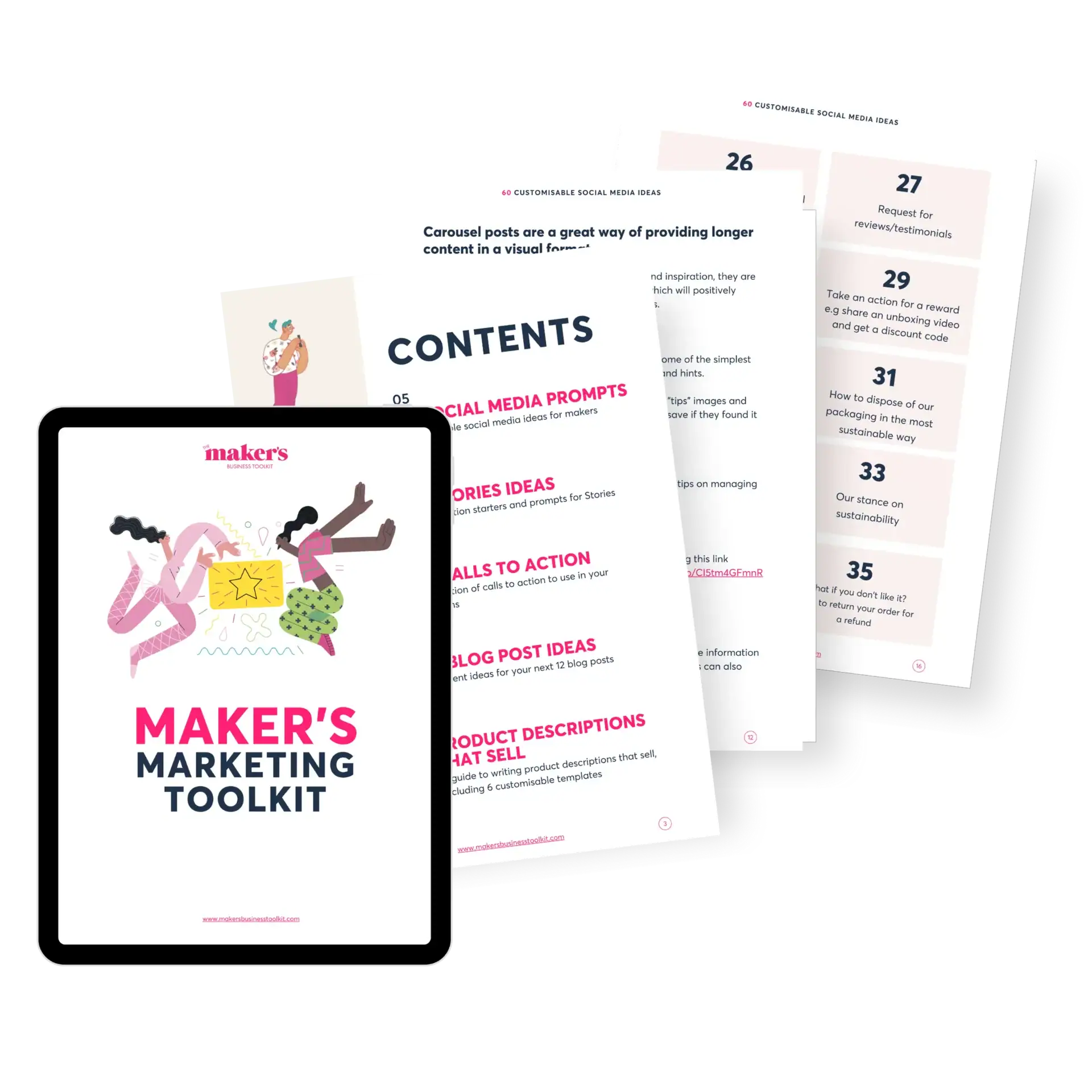
The Maker’s Marketing Toolkit gives you social post ideas grouped by the job they do, story prompts, ready-to-use calls to action, blog post starters, and a short course on how your social, email, and blog fit together, so you’ve always got somewhere to start instead of a blank page. You can take a look at it here.
Find Your Angles goes a step further and works out the messaging for your own business and products. It uncovers the real reasons people buy your particular work and turns them into 20 marketing angles, unique to you, that you can build your posts and emails around for years. Find out more here.